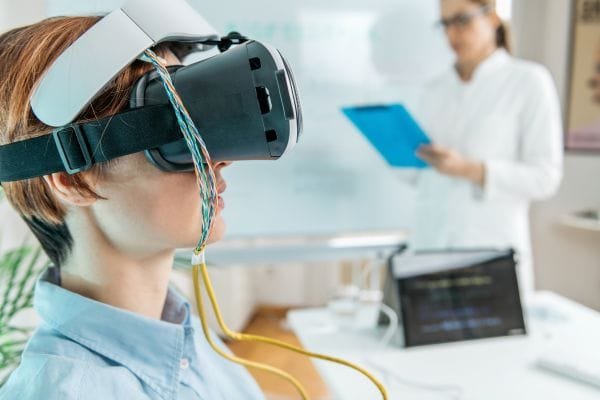
For cancer patients, the hospital chair often feels like a battlefield—the IV lines, the beeping machines, the long hours of fear and fatigue. But what if, in those very moments, a patient could be transported to a temple in Shirdi, a forest trail, or even the snow-capped Himalayas? That is the promise of Virtual Reality (VR)—and it’s already changing cancer care.
VR Is No Longer an Experiment
Across the globe, VR has moved beyond labs into real hospital wards.
- At Vanderbilt-Ingram Cancer Center (USA), patients using VR during chemotherapy reported reduced pain and anxiety.
- Pediatric oncology units abroad use VR to calm children during injections, letting them blow bubbles or play games while treatment happens.
- Meta-analyses of hundreds of patients confirm the same: VR therapy reduces pain and distress.
In India, too, first steps have begun:
- In Shillong, VR-guided imagery is offered in English, Khasi, and Hindi to calm patients during treatment.
- In Belagavi, Karnataka, VR games for children with leukemia not only improved mobility but also enhanced joy and comfort.
Why Does VR Work So Well?
- Complete Distraction—VR immerses sight and sound, reducing the brain’s ability to focus on pain.
- Physiological Calm—Heart rate slows, breathing steadies, and muscles relax.
- Sense of Control—Patients choose their virtual environment, restoring dignity.
- Positive Emotions—Lighting lamps, feeding birds, or doing yoga in VR triggers joy and peace.
- Safe & Scalable – No side effects, reusable across patients.
Why Indian Hospitals Must Act Now
India carries one of the heaviest cancer burdens globally—1 in 9 Indians may face cancer in their lifetime. While we invest in advanced drugs and machines, day-to-day suffering often goes unaddressed. VR can fill that gap:
- Pain Relief—Interactive games and calming VR scenes.
- Anxiety Reduction – Guided meditations, yoga, and mindfulness.
- Physical Recovery – Light VR-based physiotherapy through simple movements.
This is not luxury—it’s proven, patient-centered care.
The Future: VR + AI
The next leap is combining VR with AI and sensors:
- Personalized Care—AI adjusts experiences based on heart rate or stress levels.
- Movement Tracking—Encourages stretching, walking, and gentle exercises.
- Doctor Insights—Data from VR sessions can track recovery and emotional health.
Imagine a patient not just seeing the Himalayas but climbing step by step in VR, building both strength and calm.
What Does This Mean for Doctors in India?
- Clinical Role: Doctors must see VR as more than a distraction—it is therapy.
- Patient Care: Introducing VR can ease hospital anxiety, especially for children and long-term patients.
- Future Trend: Hospitals adopting VR early will set new benchmarks in patient-centered care.
At The Doctorpreneur Academy, doctors are:
- Exploring digital health tools like VR, AI, and telemedicine.
- Sharing Patient-Centered Innovations through blogs and webinars.
- Building entrepreneurial healthcare ventures that integrate comfort and dignity into treatment.
By blending medical expertise with innovation, Academy doctors are shaping a future where cancer care isn’t only about survival but also about dignity and peace.
Final Thoughts
Virtual Reality is not science fiction—it is proven care. The question is not if it works, but when Indian hospitals will start. Even a handful of VR headsets in chemotherapy bays or pediatric wards can transform patient experiences.
At The Doctorpreneur Academy, we believe it’s time to move beyond survival. Cancer care must include dignity, comfort, and hope—and VR is ready to deliver it.
👉 For Doctors: Want to lead India’s next healthcare transformation? Join The Doctorpreneur Academy and be among the first to bring VR-powered healing to your patients.
👉 To register for our next masterclass, please click here: https://linktr.ee/docpreneur