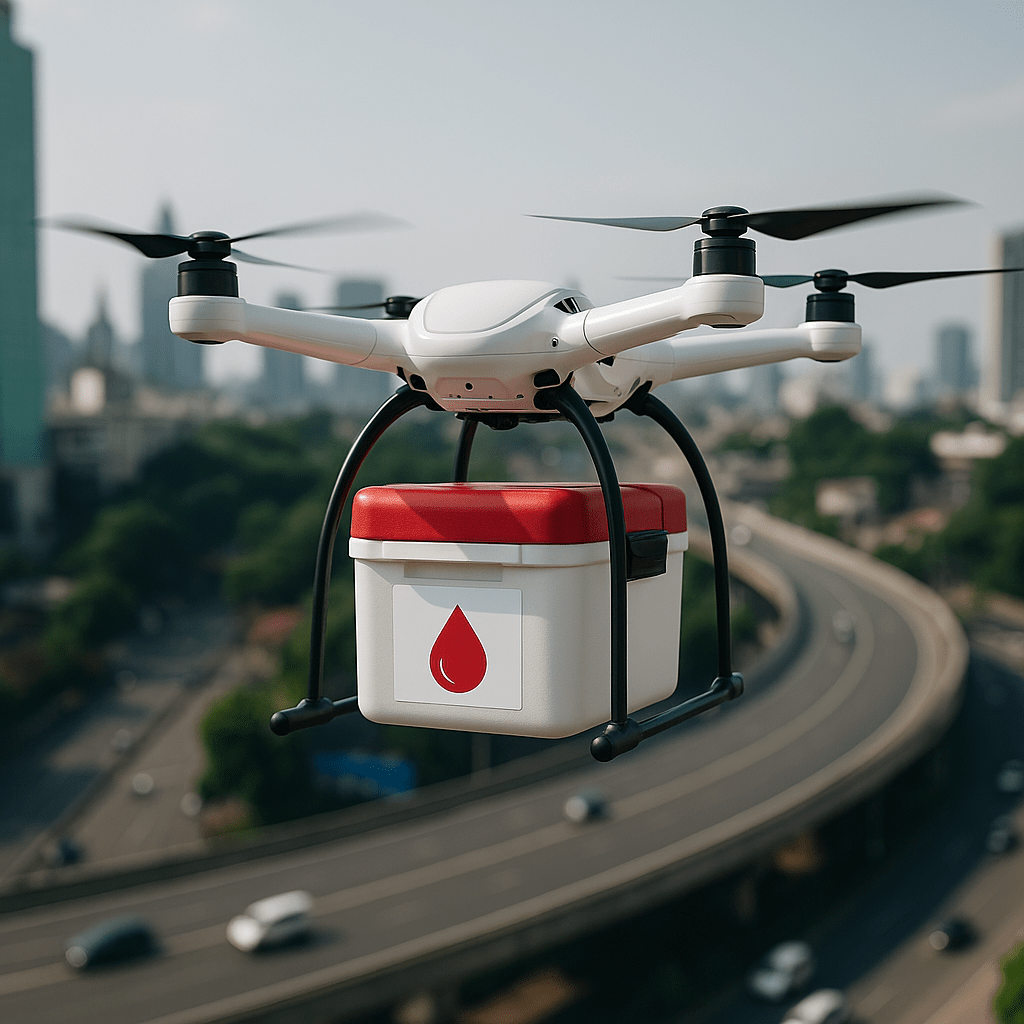
Imagine beating Delhi’s infamous traffic to save a life, not in an ambulance, but with a drone. That’s exactly what happened when a drone flew 35 km in just 15 minutes, carrying life-saving blood from Greater Noida to Central Delhi.
This wasn’t science fiction. It was a real-world trial monitored by the Indian Council of Medical Research (ICMR) and recently published in a June 2025 report. The study offers a glimpse into how drones could soon transform emergency healthcare delivery in India.
Blood by Air: A New Era in Emergency Healthcare
In 2023, a drone flew from GIMS Hospital, Greater Noida, to Lady Hardinge Medical College, Connaught Place, with 4–6 blood bags packed in temperature-controlled boxes. The flight took only 15 minutes — an hour faster than traditional road delivery.
The ICMR report titled “Adopting Drone Technology for Blood Delivery: A Feasibility Study” confirmed that the drone maintained temperature, ensured no damage to blood components (like hemolysis), and followed India’s aviation safety rules.
This success builds on previous trials — like when a drone flew 38 km to deliver eye tissue — cutting delivery time by 70%.
Why Is Blood Transport by Drone So Special?
Blood delivery is more complex than organs or vaccines because:
- Blood must be kept at strict temperatures.
- Red blood cells and platelets are fragile and sensitive to vibrations.
- Time and quality are critical — a small delay can mean the difference between life and death.
Yet, the drone managed it all — safely, quickly, and efficiently.
What the Study Found
The trial used advanced drones with vertical take-off and landing (VTOL) capabilities, real-time temperature tracking, and custom cool gel packs.
Key findings:
- Blood stayed within safe temperature limits.
- No structural damage was seen in blood cells.
- Some minor changes were similar in both drone and van delivery.
- Regulatory drone rules were followed, proving feasibility.
This makes drones a strong candidate as “first-response vehicles” in emergencies, especially in areas where road access is tough or traffic is severe.
The Challenges We Must Overcome
Despite the success, experts warn that more evidence is needed. Major challenges include:
- Cost and scalability: Drones and their equipment are expensive.
- Weather sensitivity: Drones can struggle with fog, rain, or strong winds.
- Infrastructure gaps: Rural India needs more cold chains and drone landing zones.
- Regulatory clarity: Better pan-India drone laws and coordination with air traffic are needed.
- Battery limitations: Drones still have restricted flight time and distance.
Will Drones Replace Ambulances?
Not yet, but they can outpace them in time-sensitive situations. Think of mountain villages during fog or flooded roads during monsoon. In such conditions, a flying blood unit could mean the difference between life and death.
As the Ministry of Health’s i-Drone initiative grows, we may soon see drones zipping across states to deliver blood, vaccines, and essential supplies.
At The Doctorpreneur Academy, we believe in embracing innovation that improves healthcare delivery and patient outcomes. Technologies like drone delivery, AI in medicine, and teleconsultation are no longer futuristic — they are today’s tools for tomorrow’s doctors.
If you’re a doctor looking to build leadership skills, explore digital tools, and stay updated on such game-changing trends, join us at The Doctorpreneur Academy. Learn how to lead the next wave of healthcare transformation!
Call to Action:
💡 Want to stay ahead of the curve in healthcare innovation?
👉 Join The Doctorpreneur Academy and become part of a digital-first medical community shaping the future.
👉 To register for our next masterclass, please click here https://linktr.ee/docpreneur